In 40 seconds
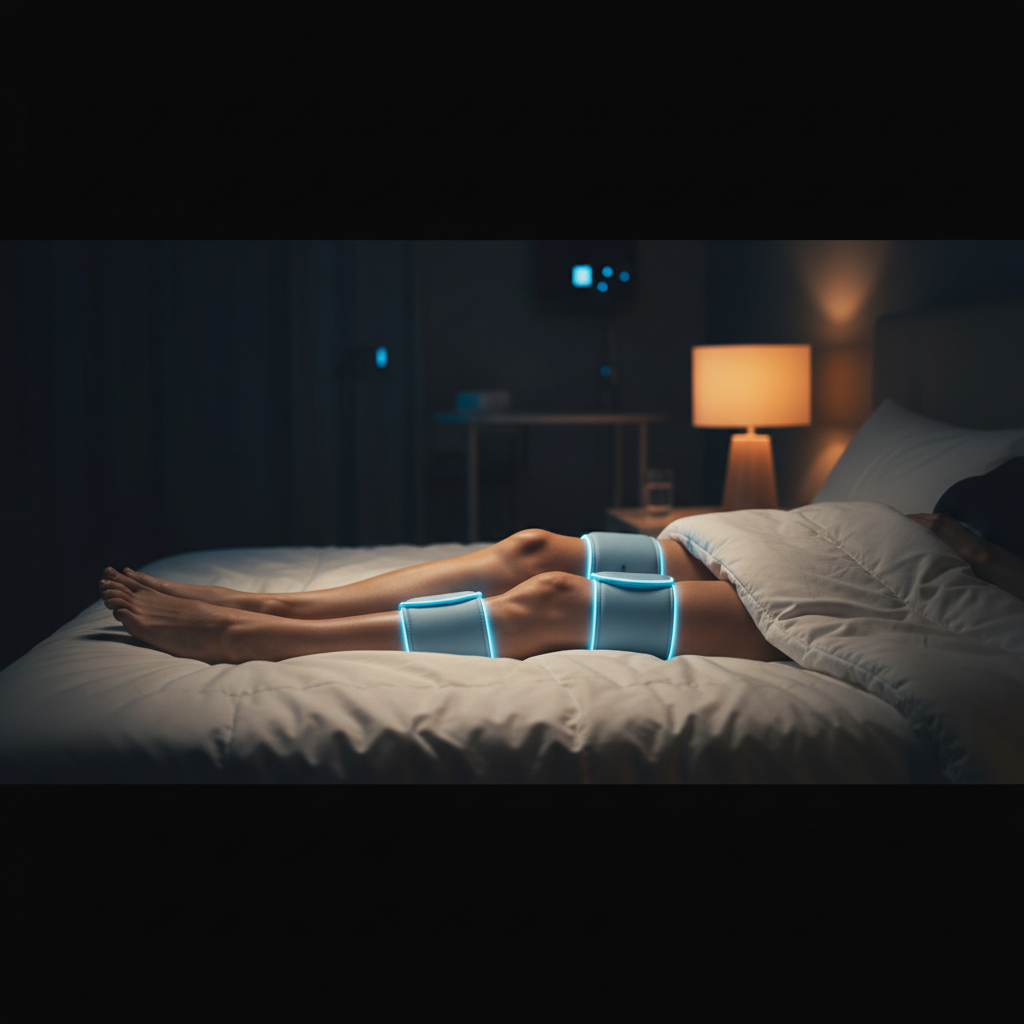
Restless Legs Syndrome (RLS) — also called Willis-Ekbom Disease — affects approximately 5–10% of UK adults. The diagnostic features: an urge to move the legs, worse at rest, worse in the evening or night, partially relieved by movement. UK care follows NICE CKS guidance: iron status check first (low ferritin is a major reversible cause), then dopamine agonists or alpha-2-delta ligands (gabapentin, pregabalin) where indicated. PEMF is a non-pharmacological adjunct studied for sleep, peripheral circulation, and the autonomic dysregulation underlying many RLS cases.
Quick facts
- UK prevalence: ≈ 5–10% of adults, more common in women and over-60s
- First test: Iron studies — ferritin should be >75 μg/L for RLS management
- Standard care: Iron correction first, then alpha-2-delta ligands or dopamine agonists per NICE
- Best PEMF evidence for: Sleep disruption, autonomic regulation, peripheral circulation
- Sessions: 30–40 minutes, evening sessions where possible, 2× per week
- Avoid: Late-evening caffeine, alcohol, antihistamines (worsen RLS)
What RLS actually is
Restless Legs Syndrome is a neurological condition with strong genetic, dopaminergic, and iron-related contributions. The four core diagnostic features (URGE):
- Urge to move the legs (sometimes arms)
- Rest worsens it
- Getting up and moving relieves it
- Evening or night-time predominance
Roughly half of cases are primary (genetic, often with family history). The other half are secondary — most commonly to iron deficiency (the single most important reversible cause), pregnancy, kidney disease, or medication (some antidepressants, antihistamines, and dopamine antagonists worsen RLS).
UK first-line care per NICE CKS: check ferritin (target >75 μg/L for RLS — higher than the general anaemia threshold), correct any iron deficiency with oral or IV iron, then add medication where symptoms persist. Alpha-2-delta ligands (gabapentin, pregabalin) are now preferred over dopamine agonists in many guidelines due to the augmentation risk with long-term dopamine agonist use.
How PEMF may help RLS
- Peripheral microcirculation — RLS has a partial vascular component; better leg circulation may reduce the urge-to-move sensation.
- Autonomic balance — RLS sufferers commonly have impaired HRV; PEMF supports parasympathetic recovery.
- Sleep architecture — RLS fragments sleep through both the leg movements themselves and through periodic limb movements (PLMS) during sleep. PEMF's slow-wave sleep effects are particularly useful.
- Pain modulation — for patients whose RLS includes a painful component, pulsed magnetic fields may dampen the relevant nerve signalling.
- Mitochondrial support — some hypotheses link RLS to mitochondrial dysfunction in skeletal muscle; PEMF may support this.
Typical UK protocol
| Phase | Frequency | Timing | Goal |
|---|---|---|---|
| Trial | 2× per week | Evening preferred | Sleep onset, urge intensity baseline |
| Loading | 2× per week | Evening | IRLS scale reduction, sleep gains |
| Maintenance | 1× per week or fortnight | Evening | Sustain response |
Use the International RLS Severity Scale (IRLS) at baseline and 6 weeks. A 5-point reduction is clinically meaningful.
What the evidence shows
- Specific PEMF trials in RLS are small but encouraging — improvements in IRLS, sleep, and subjective leg discomfort.
- Evidence extrapolates well from peripheral neuropathy and circulatory studies — RLS shares some peripheral mechanisms.
- The RLS UK patient charity takes a measured stance on adjuncts: useful for sleep on top of medical management, not a replacement for iron correction or prescribed medication.
- The honest UK position: PEMF is a reasonable adjunct for RLS patients who have completed the iron and medication work and still struggle with sleep.
Practical advice before booking
- Get ferritin checked first — it's the single most important reversible cause and is missed surprisingly often. Target >75 μg/L for RLS specifically.
- Review your medications — some antidepressants (SSRIs, SNRIs, tricyclics), antihistamines, and dopamine-antagonist medications worsen RLS. Don't stop unilaterally; discuss with your GP.
- Avoid evening caffeine and alcohol — both worsen RLS for most sufferers.
- Don't expect PEMF to replace medication — particularly if you're already on alpha-2-delta ligands or dopamine agonists.
- Track IRLS and sleep — without numbers you can't judge.
Related guides on PEMF UK
PEMF for insomnia and sleep
RLS-disrupted sleep responds to similar PEMF protocols.
AdjacentPEMF for peripheral neuropathy
Different condition often confused with RLS.
ComorbidityPEMF for anxiety
Anxiety frequently co-occurs with RLS.
Contraindications
Hard exclusions — do not have PEMF if any apply:
- Pacemaker, implantable cardioverter-defibrillator (ICD), or any cardiac electronic device
- Cochlear implant or other implanted electronic hearing device
- Spinal cord stimulator, deep-brain stimulator, vagus nerve stimulator
- Intrathecal pump or implanted drug pump
- Insulin pump (continuous glucose monitors are usually fine — confirm with the clinic)
- Active infection at the treatment site
- Pregnancy — when treatment would be over the abdomen, lumbar spine, or pelvis
Discuss with your GP or specialist before booking if any apply:
- Active malignancy or recent cancer history (oncologist clearance required)
- History of seizures or epilepsy
- Multiple sclerosis or other neurological condition under specialist care
- Anticoagulant therapy (PEMF itself does not thin blood, but bruising risk if local circulation is already compromised)
- Children under 14 (most UK clinics will not treat under-18s without paediatric specialist input)
- Recent surgery within the last 14 days at the treatment site (confirm with surgeon)
NOT contraindications — these are commonly misunderstood:
- Plates, rods, screws and other passive metal orthopaedic hardware
- Dental implants and dental crowns
- Joint replacements (hip, knee, shoulder)
- IUDs (copper or hormonal)
- Tattoos and piercings (jewellery should be removed for the session)
Specific to this condition: Get ferritin checked before pursuing any RLS treatment — low iron is the single most important reversible cause. Don't stop prescribed RLS medication (alpha-2-delta ligands, dopamine agonists) without GP supervision; abrupt withdrawal can cause severe symptom rebound.
Frequently asked questions
Why do I need a ferritin check first?
Iron deficiency is the most common reversible cause of RLS, and ferritin is missed in routine bloods. RLS-specific guidance recommends ferritin >75 μg/L (much higher than the general anaemia threshold). If yours is below this, oral or IV iron correction often dramatically improves symptoms.
Can PEMF replace my pregabalin / pramipexole?
No, not without GP input. PEMF is an adjunct. Alpha-2-delta ligands (gabapentin, pregabalin) and dopamine agonists (pramipexole, ropinirole) require gradual GP-supervised tapering if you're going to come off them — abrupt cessation causes severe symptom rebound.
Does PEMF stop the urge-to-move during a session?
Many patients find the urge to move reduces during a session — particularly evening sessions. The longer-term benefit comes from sleep architecture changes over weeks of regular use.
Is RLS a circulation problem?
Partly. RLS has neurological, dopaminergic, iron-related and partial peripheral circulation components. PEMF addresses the circulation and autonomic angles; it doesn't directly fix the dopaminergic component.
How fast will I see changes?
Sleep onset is usually the first thing to move (1–2 weeks). IRLS scale reduction typically shows by 4–6 weeks. If no movement at 6 weeks the response is unlikely to develop later.
What's the UK cost?
Typical UK private clinic pricing is £40–£90 per session. A 6-week course costs £400–£600. Evening time slots may be at premium pricing.
Find a PEMF clinic near you
We list every credible PEMF therapy provider in the UK so you can find one near home.